
An Indian national was killed and several others injured in a drone attack on Kuwait International Airport, leading to the suspension of air traffic and significant damage. This incident marks the tenth Indian fatality since hostilities between the US and Iran began in February, with other Indians also affected by regional conflicts in UAE, Saudi Arabia, and Oman.

'The West Asia or the Gulf crisis has shown that what we develop as national infrastructure when things are not as bad as they could be, we forget to plan for adversities.'

Two Indian ships carrying liquified petroleum gas (LPG) from the Gulf countries crossed the Strait of Hormuz early on Saturday morning, raising the number of Indian vessels safely passing through the war-hit, narrow shipping lane to three.
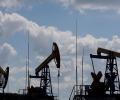
India's Russian crude oil imports reached a five-month low in September, dropping to 1.75 million barrels per day, as Indian refiners strategically diversify their energy supplies amidst evolving geopolitical landscapes and robust domestic demand, according to ship tracking data.

The cost of the war is being counted not in the corridors of power in Washington or Tehran, but in Firozabad's darkened furnace rooms, Howrah's idle casting sheds, and a barbershop in Kochi where the wait is suddenly, inexplicably, an hour long, notes Prem Panicker in his must read blog on the Iran War.

24 Indian-flagged vessels with 677 Indian seafarers were currently located west of the Strait of Hormuz, and four vessels with 101 Indian seafarers were stationed east of the strategic waterway.

Iranian President Masoud Pezeshkian concluded his visit to India for the 18th BRICS Summit, announcing that Iran and the UAE agreed to move past previous tensions. This diplomatic breakthrough occurred during talks with Abu Dhabi's Crown Prince on the summit sidelines. Pezeshkian also met with PM Modi to discuss bilateral ties and West Asia developments, with Modi emphasising dialogue for regional peace. The BRICS summit adopted the New Delhi Declaration 2026, calling for global governance reforms and de-escalation in West Asia.

Former US President Donald Trump claimed victory over Iran, stating they agreed to never have a nuclear weapon and provided a 'significant prize' related to the Strait of Hormuz. He also suggested a change in Iranian leadership and acknowledged Pakistan's role in facilitating talks.

Any military response to a cross-border terror attack from Pakistan will have to take into account the new alignments beginning to take shape in the region, points out former foreign secretary Shyam Saran.

Pakistan's government is exploring measures, including potential smart lockdowns and austerity, to reduce petroleum consumption. This comes after recent fuel price hikes driven by rising global oil prices and West Asia tensions, which have also raised concerns about oil supply disruptions. The government is also implementing a fuel relief scheme and faces public pressure over the price increases.

Former Central Command chief David H Petraeus suggests the US and Iran are likely to extend their ceasefire beyond the initial two-week period, citing willingness from both sides to continue negotiations.

Crude oil futures surged over 3 per cent, snapping a three-session losing streak, as renewed military escalation in West Asia revived fears of supply disruptions, driving prices higher on both domestic and international exchanges.

External Affairs Minister S Jaishankar has engaged in multiple conversations with his Iranian counterpart to secure safe passage for Indian merchant vessels through the Strait of Hormuz amidst escalating tensions in West Asia.

A senior government official confirms that Indian vessels do not require permission to navigate the Strait of Hormuz, despite regional tensions. Several Indian ships, including LPG tankers, have safely crossed the strait, ensuring continued supply of essential commodities to India.

Indian benchmark indices, Sensex and Nifty, experienced declines in early trade due to elevated crude oil prices, escalating US-Iran hostilities, and renewed concerns over a potential US interest rate hike.

Seven Indian-flagged vessels, carrying 148 seafarers, are currently in the Persian Gulf region amidst escalating military tensions between the US and Iran. An Indian crew member was killed in a recent attack on a merchant ship, raising concerns about maritime safety and the fragile US-Iran peace deal.
India's foreign policy establishment is adjusting with alacrity in real time -- an extraordinary spectacle in itself, considering the manifest reluctance to indulge in public diplomacy critical of American moves, observes Ambassador M K Bhadrakumar.

US President Donald Trump said on Wednesday that Washington is considering a "joint venture" with Iran to secure the Strait of Hormuz, following his announcement of a two-week ceasefire.

The US Navy seized an Iranian-flagged cargo ship in the Gulf of Oman, escalating tensions as ceasefire talks face uncertainty. The incident raises concerns about the fragile ceasefire and the ongoing blockade of the Strait of Hormuz.

Two more Indian-flagged LPG tankers have begun their journey from the Persian Gulf, navigating the Strait of Hormuz amidst regional conflict, following disruptions caused by recent tensions in the Middle East.

Prime Minister Narendra Modi on Thursday discussed with a group of senior ministers the prevailing global security situation and how to maintain supply chain uninterrupted despite conflicts in different zones, including the Strait of Hormuz, the Black Sea, the Red Sea, and the Gulf of Aden.

...reopen for up to six months. Until then, the Strait stays nearly closed. The world pays. And no one, including the man who started this, can say when it ends, notes Prem Panicker in his must read blog on the Iran War.

Amid escalating tensions with Iran, President Trump is urging nations dependent on Middle Eastern oil to deploy warships to the Strait of Hormuz to safeguard critical global energy supplies.

The US Central Command announced a new wave of strikes against Iranian military infrastructure, aiming to degrade Tehran's ability to threaten civilian mariners and commercial vessels. This comes as US President Donald Trump described the situation as a 'skirmish' and suggested Iran wants to 'make a deal,' while Iran's Foreign Minister warned of a 'decisive response' to any aggression.

The question is no longer whether the war will expand. It has. The next few days will tell us whether the war stabilises around Hormuz or whether the Strait itself becomes the trigger for a far larger rupture. What to watch for over the next 48 hours is simple: Any move by the US toward direct naval control of the Strait; any credible Iranian attempt to disrupt or mine shipping lanes and, critically, whether energy infrastructure in the Gulf continues to be targeted.If those lines are crossed in tandem, the war will no longer be containable within the region.

US President Donald Trump has abruptly withdrawn from a peace deal with Iran, citing fresh intelligence of Iranian assaults on commercial vessels in the Strait of Hormuz. The decision, made just a fortnight after celebrating the deal, has led to a significant military escalation in the region, with the US launching extensive counter-operations against Iranian military infrastructure.

Defence Minister Rajnath Singh assures India's energy security amidst West Asia tensions, highlighting naval protection of tankers and readiness to counter cross-border terrorism.

Two more Indian-flagged LPG tankers have safely navigated the Strait of Hormuz, ensuring continued cooking gas supply to India amidst regional conflict. These tankers are expected to reach Indian shores soon, following the successful transit of previous vessels.

The escalating conflict in West Asia has resulted in 19 ships carrying essential energy resources for India being stranded in the Strait of Hormuz, raising concerns about potential disruptions to the country's energy supply.

Indian benchmark indices, Sensex and Nifty, experienced declines in early trade due to a significant spike in crude oil prices, driven by escalating geopolitical uncertainties, despite positive cues from Asian and US markets.

Prime Minister Narendra Modi, addressing the BRICS summit, called for a fundamental shift in global governance, advocating for the replacement of the current 'pyramid of privilege' with a 'platform of partnership' where the Global South becomes a 'rule shaper' rather than a 'rule follower'.

How US President Donald Trump employed a clandestine 'decoy' Air Force One operation to secretly depart Turkiye following a NATO Summit.

US President Donald Trump on Friday (local time) said the United States could "hit" Iran's heavily fortified underground nuclear site known as Pickaxe Mountain "very soon", days after Washington targeted Iranian military targets.

The Islamic Revolutionary Guard Corps (IRGC) has announced a series of military operations against US and Israeli targets in retaliation for earlier airstrikes. The IRGC claims to have launched multiple missile and drone strikes, and has warned against any potential ground operations within Iranian territory.

Qatar remains committed to hosting November's MotoGP and Formula One races despite regional uncertainty, with Lusail preparations continuing and Formula One set to decide the race's fate.

Indian benchmark equity indices, Sensex and Nifty, experienced declines in early trade due to a surge in Brent crude oil prices, which rose above USD 90 per barrel, coupled with subdued global cues and ongoing US-Iran skirmishes. Track Sensex, Nifty on Auigust 12.

Donald Trump stated that Iran has been given a "last chance" to reach an agreement, revealing that the US paused a planned military strike after receiving requests from Saudi Arabia, the UAE, Qatar, and Iran to pursue diplomacy instead.

US Central Command (CENTCOM) forces conducted additional strikes against multiple targets in Iran, on Saturday (local time), at the commander in chief, US President Donald Trump's direction.

Iran's Islamic Revolutionary Guard Corps (IRGC) on Sunday claimed it had destroyed eight US military infrastructures in Kuwait and Bahrain in a joint missile and drone operation, describing the strikes as retaliation for a second wave of US military attacks on Iranian targets.

The Centre on Monday told the Supreme Court that authorities in Muscat are examining claims that the family of Indian merchant navy captain Ashish Kumar received ransom calls following his disappearance after a drone or missile attack on a vessel in the Strait of Hormuz.
